
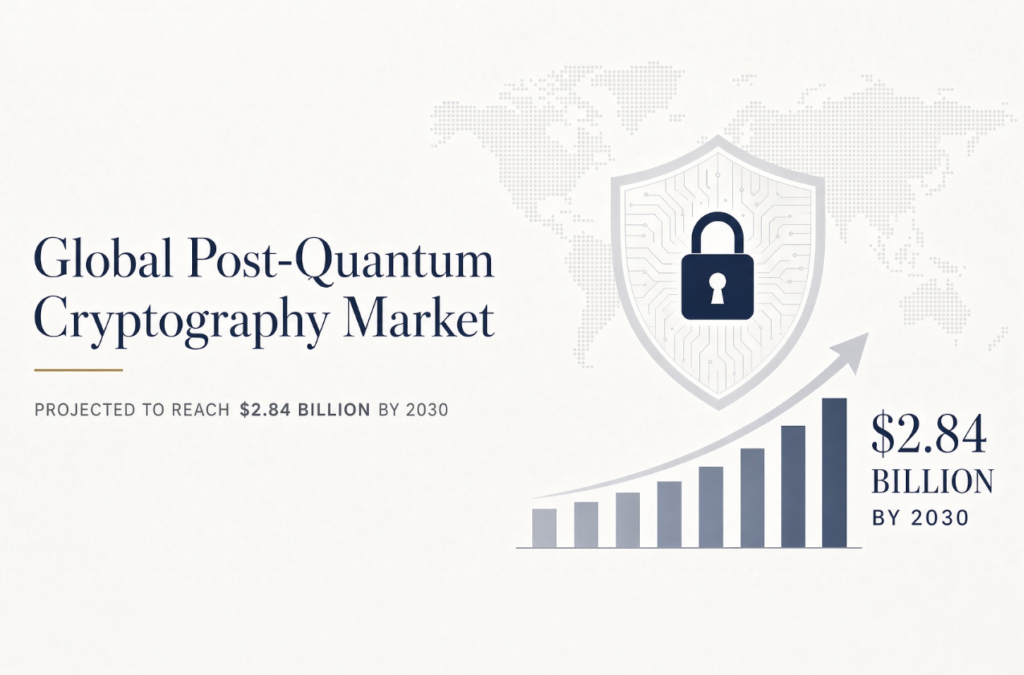
The market for post-quantum cybersecurity is moving from a research concern to a business priority as governments and enterprises begin preparing for the possibility that future quantum computers could undermine widely used encryption systems, according to USA News Group PQC market size report.
The global post-quantum cryptography market size could grow from about $420 million in 2025 to roughly $2.84 billion by 2030, representing an annual growth rate of about 46%, according to market projections cited by USA News Group. The firm said increasing cyber threats, regulatory pressure and concerns over so-called “harvest now, decrypt later” attacks are accelerating demand for technologies designed to protect sensitive information against future quantum-enabled attacks.
The “harvest now, decrypt later” threat refers to the practice of collecting encrypted data today with the expectation that sufficiently powerful quantum computers may eventually be able to break the encryption. That possibility has prompted governments, financial institutions and critical infrastructure operators to begin assessing how they will transition to quantum-resistant security standards.
Post-Quantum Cryptography Market Size Drivers
Other analysts have projected different market sizes while pointing to similar drivers. Mordor Intelligence estimates the post-quantum cryptography market size could grow from approximately $880 million in 2025 to $4.6 billion by 2030, citing regulatory requirements, new standards from the National Institute of Standards and Technology and increased government investment.
The transition is being shaped in part by NIST’s effort to standardize post-quantum cryptographic algorithms that organizations can deploy as replacements for vulnerable public-key encryption methods. Early demand has centered on helping companies understand their existing cryptographic systems, identify risks and develop migration plans.
Among the companies highlighted by USA News Group is QSE – Quantum Secure Encryption Corp., a Canadian cybersecurity company focused on post-quantum data protection, identity security and cryptographic migration readiness. The company recently announced that it had been selected as a member of the Public Key Infrastructure Consortium, an industry group focused on digital identity, certificate infrastructure and secure online communications.
According to QSE, the membership provides opportunities to participate in discussions around certificate management, cryptographic agility and post-quantum readiness. The consortium includes organizations involved in digital certificates, certificate authorities, telecommunications, financial services, public-sector security and cybersecurity.
Purchase Orders as Evidence
The announcement follows several recent developments for the company. In July, QSE secured what it described as its first major financial-services purchase order for its Quantum Preparedness Assessment platform from the Malaysian operations of a global insurance and asset-management group.
“This purchase order is an important milestone because it demonstrates that our QPA platform is being adopted by the type of customer that faces some of the highest security and compliance expectations in the market,” Ted Carefoot, chief executive officer of QSE, said in a statement.
The company also introduced QSE QScope, a cryptographic discovery tool designed to help organizations create inventories of their existing encryption systems and prepare for migration. In August, QSE closed the first tranche of a previously announced private placement, raising about $5.3 million.
While cybersecurity companies are positioning themselves to benefit from the expected migration cycle, adoption timelines remain uncertain. Organizations must evaluate their existing technology environments, determine which systems require upgrades and coordinate changes across suppliers and internal infrastructure.
The broader quantum technology industry is also seeing increased commercial activity, according to USA News Group.
IonQ, a quantum computing company, reported second-quarter 2026 revenue of $80.1 million, up 287% from a year earlier, and raised its full-year revenue guidance to $290 million. The company attributed growth to increased system deployments, cloud usage and its acquisition of SkyWater Technology.
D-Wave Quantum reported second-quarter revenue of $3.1 million, while bookings increased 59% year over year. The company reported that first-half bookings reached $35.5 million, driven in part by a $20 million system contract with Florida Atlantic University.
Rigetti Computing, which develops superconducting quantum computers, reported a balance sheet with $569 million in cash, equivalents and marketable securities, although the company remains focused on development rather than profitability.
Arqit Quantum, which develops encryption technology aimed at protecting data from future quantum threats, has focused on enterprise, telecommunications and government customers seeking quantum-safe communications.
The developments reflect a broader transition within cybersecurity, where organizations are beginning to treat quantum readiness as a long-term infrastructure issue rather than a future research challenge. While large-scale quantum computers capable of breaking today’s encryption systems have not yet been built, government timelines and compliance requirements are encouraging companies to begin planning the migration process.