

What the New Post-Quantum Cryptography Executive Order Means for Quantum Security Leaders
The federal government has finally attached firm dates to a problem that quantum security leaders have been warning about for a decade.
The federal government has finally attached firm dates to a problem that quantum security leaders have been warning about for a decade.

China and Russia are stealing encrypted U.S. secrets now in the expectation that future quantum computers will let them read the data later, Anne Neuberger writes in Foreign Affairs. The warning puts a practical timeline on one of the most discussed risks in quantum technology. A large enough quantum computer could break some of the
The same machines that could one day break parts of the modern encryption system are themselves exposed to new forms of attack.
Quantum Computing Could Break Encryption and Expose Its Own Security Gaps, Study Finds Read More »

Two New York lawmakers want Congress to take a hard, structured look at where the United States actually stands in quantum computing
Would a National Security Commission on Quantum Computing Affect Quantum Security? Read More »
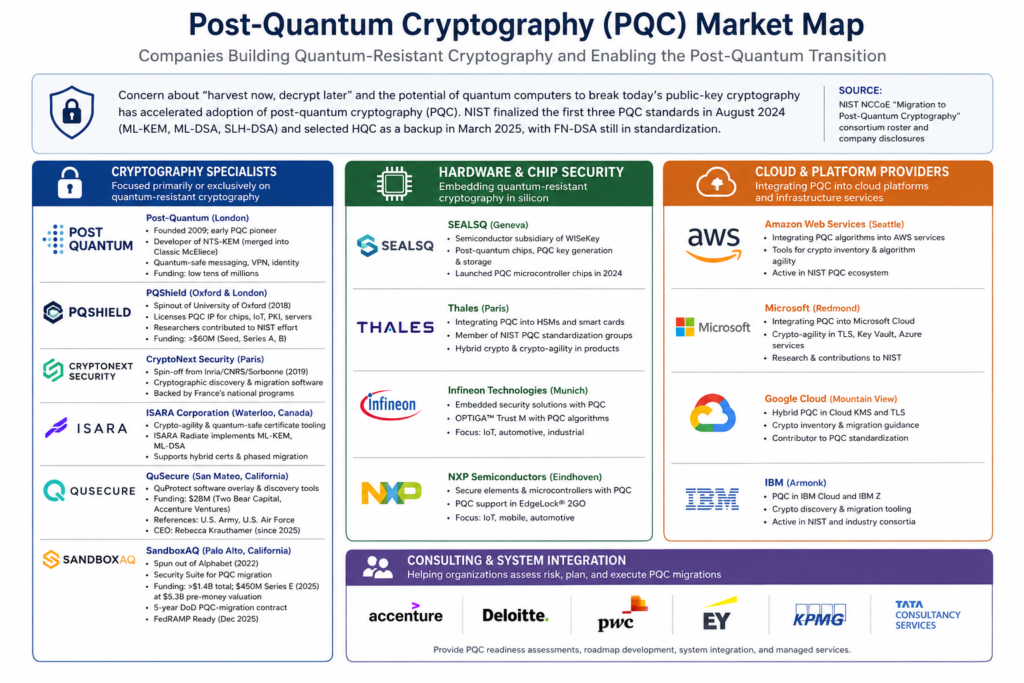
An overview of the market for the post-quantum cryptographic industry.
Companies Building The Quantum-Resistant Cryptography Industry Read More »

Most of the secrets that keep modern life running—bank transfers, private messages, the little padlock in your browser’s address bar—are protected by math that today’s computers cannot solve in any reasonable amount of time. Shor’s algorithm is the reason cryptographers worry that this won’t last. Devised in 1994 by mathematician Peter Shor, then at Bell
What Is Shor’s Algorithm? Read More »

Post-quantum cryptography (PQC) has moved from a research topic to an operational priority. With NIST’s first standards finalized, federal mandates in force, and major technology providers already migrating, security and engineering teams need a working understanding of what is changing and why. This PQC Resource Guide identifies credible resources for building that understanding — organized
How to Train Your Team on Post-Quantum Cryptography: A Practical PQC Resource Guide Read More »

Organizations should begin preparing for the quantum computing era today, according to a new German cybersecurity guide that warns that waiting for powerful quantum computers to arrive could leave sensitive data exposed years before the technology becomes operational. The report, “Post-Quantum Cryptography in Practice: A Guide for Long-Term IT Security,” was published by researchers Leonie
German Cybersecurity Researchers Urge Immediate Shift to Post-Quantum Cryptography Read More »

Healthcare organizations are racing to digitize patient care, but a new study reports these organizations must also prepare for quantum computing, a cybersecurity challenge that could arrive years before many institutions are ready. Researchers writing in the International Journal of Theoretical and Applied Computational Intelligence warn that advances in quantum computing could eventually undermine the
The mathematics that secures your organization’s data today was designed for a world without quantum computers. That world is ending. NIST published its first post-quantum cryptography standards in August 2024. Cloudflare reported in April 2026 that more than 65% of human web traffic through its network already uses post-quantum methods. IBM and Google have both