
Quantum B has secured a European patent covering a method that uses quantum-generated correlations to help participants in a distributed network agree on shared data, the company announced in a press release.
The patent covers Quantum B’s Quantum Conference Key Agreement protocol and its use in systems such as blockchain networks and multiparty data-sharing platforms. These systems require independent computers, known as nodes, to maintain a consistent record even when the participants do not necessarily trust one another.
Quantum B, formerly known as Quantum Blockchains, said its approach introduces quantum entanglement into that agreement process. The patented method distributes quantum information to participating nodes, allowing them to produce correlated measurement results that contribute to a collective decision.
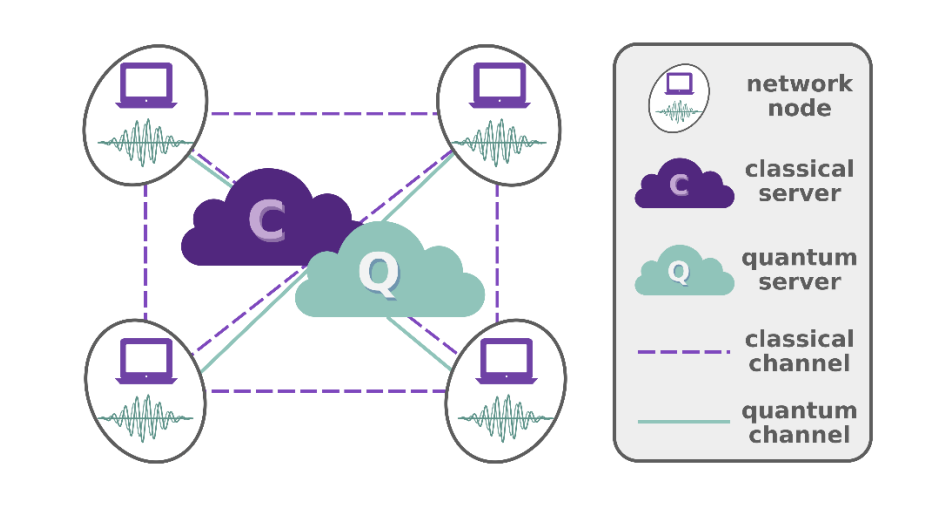
Under the system described in the patent, a quantum server generates photons encoded according to their arrival times and converts them into entangled states known as time-bin Greenberger-Horne-Zeilinger, or GHZ, states. The server then distributes quantum information to the network’s nodes, which also communicate through conventional internet channels.
Each node measures the quantum information it receives and converts the result into bit values. The nodes share additional calculated values and compare their results. A node acts on a block of shared data when its locally calculated value agrees with the majority of the values received from other participants. The network reaches agreement when the processed data is consistent across the nodes.
The approach is intended to give a distributed network a source of coordinated randomness rooted in quantum physics. Conventional blockchain systems typically rely on classical methods such as proof-of-work, proof-of-stake or voting procedures to determine which transactions or records should be accepted.
Quantum B’s protocol does not eliminate classical communication. Instead, it combines classical internet connections with correlations produced through quantum measurements. The company said this could reduce a network’s exclusive dependence on classical cryptographic assumptions and sources of randomness.
“This patent is the result of work we began some time ago, but our research has advanced significantly since then,” said Mirek Sopek, CEO of Quantum B. “Since filing the patent application, we have continued to develop both the protocol itself and new approaches to distributed consensus. Today, our work has progressed well beyond the solutions described in the granted patent, and we are developing new results that we intend to share as they mature. This is an important milestone, but not the endpoint of our research.”
“When many participants in a system need to agree on a common result, classical approaches typically require complex communication between them. In our research, we investigated whether quantum entanglement could simplify this process by enabling multiple participants to obtain correlated outcomes simultaneously. The granting of the patent for our solution confirms the innovative nature of the concept and supports the research direction we have chosen,” said Miriam Kosik, co-inventor.
The patent marks an intellectual-property milestone rather than the deployment of a commercially operating network. Using the method would require infrastructure capable of generating, distributing and measuring multipartite entangled states. Maintaining those states across a practical network remains technically difficult because photon loss, noise and measurement errors can disrupt quantum correlations.
The company did not disclose performance results, implementation costs or plans for a commercial deployment. It also did not compare the patented protocol’s speed, security or communication requirements with existing consensus mechanisms.
The company is also developing post-quantum and quantum-security technologies, including a hardware platform designed to emulate quantum key distribution. Quantum B participates in European Union-funded research projects, including POSEIDON, which focuses on post-quantum security for European digital identity systems.