Researchers demonstrated quantum key distribution across an 18-kilometer free-space link by using adaptive optics to counter atmospheric turbulence and connect the signal to conventional fiber infrastructure.
The field trial in northeastern Italy generated secret encryption keys at an average rate of about 1,000 bits per second with superconducting detectors and 200 bits per second with compact detectors operating at room temperature. The results, published in npj Quantum Information, could support hybrid quantum networks linking fiber systems with ground stations and satellites.
Future quantum networks will need to transmit quantum signals through several types of channels, according to the team, which included scientists from the University of Padua, ThinkQuantum and Italy’s National Research Council. Fiber can connect users across cities and regions, while free-space links can reach locations without direct cable connections and provide access to satellites.
Moving signals between the two is difficult. Changes in air temperature and density distort light traveling through the atmosphere, much as hot air causes distant objects to shimmer. These distortions make it harder to focus arriving photons into the narrow core of an optical fiber.
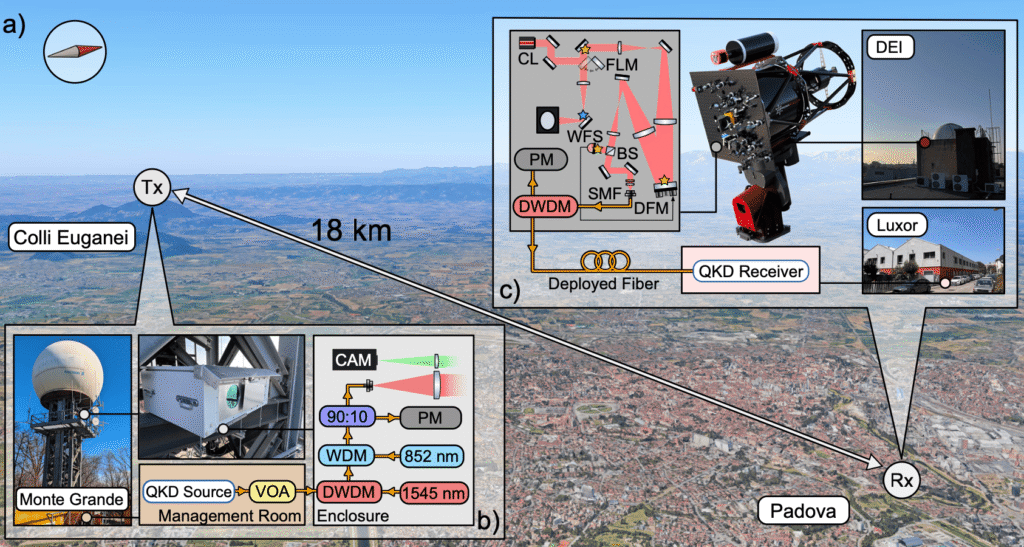
The researchers addressed the problem with adaptive optics, a technology also used in astronomy to sharpen telescope images. Their system measured distortions in the arriving light and adjusted a deformable mirror to counter them in real time.
The experiment connected a transmitter on Monte Grande in Italy’s Colli Euganei region with an optical ground station at the University of Padua. The signal traveled 18 kilometers through the air before a telescope with a 41-centimeter aperture collected it. The corrected light was placed into standard single-mode fiber and carried another half-kilometer to a quantum key distribution receiver in a separate building.
Quantum key distribution, or QKD, allows two parties to establish a shared encryption key using quantum states. An interceptor who measures those states can disturb them, producing errors that may reveal the attempted interception.
The final key is not transmitted intact. The sender and receiver measure a series of quantum signals and compare certain information over a conventional communication channel. They then use the compatible results to create a shared secret key.
The experiment used commercial QKD equipment operating at a wavelength of 1,565.50 nanometers. That is roughly 50 times thinner than a human hair and falls in the near-infrared range commonly used by telecommunications networks.
The system produced secure keys despite total signal losses of about 30 decibels, meaning only around one-thousandth of the original signal remained at the receiver.
With high-efficiency superconducting detectors, the system recorded an average secret key rate of about 1,000 bits per second and a quantum bit error rate below 1%. Room-temperature detectors produced about 200 secret bits per second with an error rate near 2%.
The room-temperature result could be important for practical systems because superconducting photon detectors require cryogenic cooling. Detectors that operate without such cooling could reduce the cost, power demands and complexity of quantum communication terminals, although they currently offer lower performance.
The commercial QKD equipment was originally designed for fiber networks but required no functional changes for the hybrid link. The optical ground station also acted as a transparent relay, correcting and transferring the signal without measuring the quantum information.
The trial was limited to a fixed ground link under weak-to-moderate turbulence. It did not test a moving satellite, severe weather or continuous daytime operation, when stronger atmospheric effects can make correction more difficult.
The researchers said faster adaptive-optics controllers and automated fiber alignment could improve performance. The approach could eventually support satellite QKD and other quantum networking tasks, including entanglement distribution for computing, communication and sensing.