
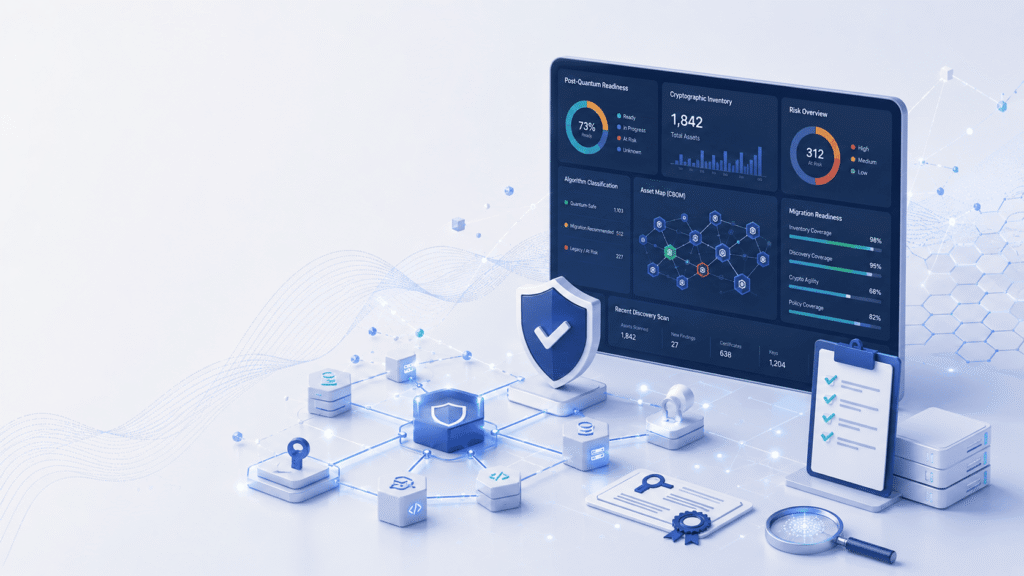
Most coverage of the quantum threat fixates on when a quantum computer become powerful enough to break the encryption securing the internet. Unfortunately, it may be the wrong question for most of the people reading this. For the typical bank, hospital, utility, or government contractor, the binding constraint isn’t the arrival of “Q-Day.” It’s a far more mundane problem that has to be solved first, and that almost no organization can answer on demand. That question is the entire reason a category called quantum cybersecurity audit companies now exists.
Before any organization can swap vulnerable algorithms for quantum-resistant ones, it has to find every place those algorithms are hiding — in TLS certificates, VPNs, code-signing keys, firmware, embedded devices, database engines, internal certificate authorities, and the long tail of vendor software it doesn’t control. That discovery-and-assessment work is the audit and, as of late June 2026, it is no longer optional for a large slice of the economy.
Why this Market Has a Deadline
On June 22, 2026, the White House signed an executive order titled Securing the Nation Against Advanced Cryptographic Attacks. (Outlets have referenced it by different EO numbers; the title and signing date are the reliable identifiers.) It converts years of voluntary guidance into a fixed schedule. As Federal News Network reported, federal agencies must move their highest-value systems to post-quantum key establishment by December 31, 2030, and to post-quantum digital signatures by the end of 2031 — pulling the previous 2035 horizon several years closer. Agencies had to name a dedicated PQC migration lead within 30 days, and, as Cybersecurity Dive noted, the order sets in motion procurement rules that push the same obligations onto government contractors.
Two details inside that order are what give audit firms their business. First, agencies must inventory their cryptographic assets before they can migrate them. Second, the order directs CISA and NIST to define the minimum elements of a Cryptographic Bill of Materials (CBOM) — essentially an ingredient list of every algorithm, key, certificate, and library a piece of technology uses, designed to be machine-readable so it can be assessed automatically.
A CBOM is the deliverable at the heart of a quantum cryptography audit. And the inconvenient truth the order quietly acknowledges is that, after thirty years of cryptography accreting through enterprise systems with nobody drawing a map, hardly anyone — in government or industry — knows what they’re running. The mandate didn’t create that risk, it put a date on a reckoning that was always coming.
It’s worth being precise about the urgency rather than hyping it. The driver isn’t that a code-breaking quantum computer exists today; current machines can’t break RSA-2048. It’s “harvest now, decrypt later” — adversaries collecting encrypted data now to decrypt once the hardware matures — combined with the fact that cryptographic migrations historically take 10 to 20 years. Data that must stay secret into the 2030s is exposed today, and the migration to protect it is slow. That combination, not a doomsday clock, is what makes the audit a present-tense task.
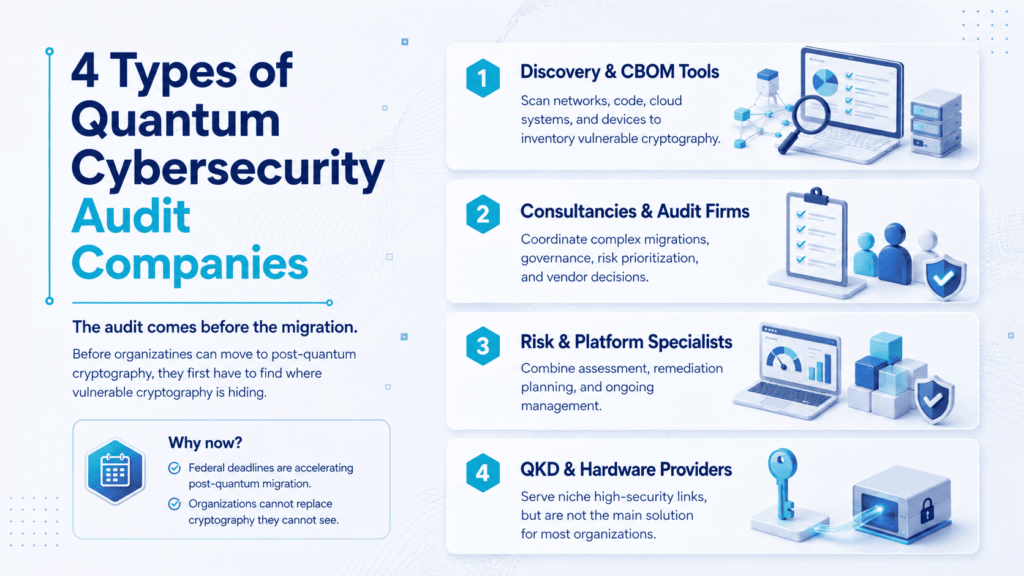
Four Kinds of Quantum Cybersecurity Audit Companies
The phrase “quantum cybersecurity audit companies” lumps together firms with genuinely different business models. Knowing which type you’re talking to matters more than any brand name.
1. Cryptographic discovery and CBOM tooling vendors
These quantum cybersecurity audit companies build the scanners and platforms that find cryptography across networks, source code, cloud environments, and devices, then produce a classified inventory flagging quantum-vulnerable assets (RSA, ECC, ECDSA, Diffie-Hellman) for prioritization.
The recognized names here, per QNu Labs’ rundown of leading 2026 discovery tools, include IBM, whose Quantum Safe Explorer targets enterprise codebases and mainframe environments; SandboxAQ, whose AQtive Guard emphasizes large-scale, AI-assisted discovery and which partners with endpoint and network vendors such as CrowdStrike and Palo Alto Networks; and Keyfactor, which acquired the discovery specialist InfoSec Global in 2025 to fold CBOM-grade inventory (the former CipherInsights passive-scanning approach) into its certificate-management platform. Encryption Consulting, QuSecure (QuProtect R3), Palo Alto Networks — which launched a quantum-safe offering in early 2026 centered on a continuously updated CBOM and “drift detection” — and Arqit (Encryption Intelligence) round out a crowded and fast-consolidating field.
2. The big consultancies and audit firms
This is where most large enterprises and agencies will actually run their programs, because the bottleneck is in coordinating a transition across complex, multi-vendor environments and translating technical findings into board-level decisions.
According to the Quantum Insider’s survey of the market, Accenture, Deloitte, EY, PwC, KPMG, TCS, Wipro, Capgemini, NTT Data, and DXC Technology all offer quantum-safe advisory of varying depth including cryptographic inventory, risk prioritization, migration roadmapping, and vendor selection. One revealing detail about how these engagements work is that at a firm like Deloitte, much of the value — and the fee — comes from translation. Consultants pull certificate inventories from cloud workloads one day and interview the legal department about vendor contract clauses the next, then package the same technical findings in three different formats for three different audiences, from engineers to the audit committee.
Separately, internal-audit functions are being pulled in. Firms such as Grant Thornton are advising audit teams to treat quantum readiness like any other enterprise risk — assessing the cryptographic inventory and PQC transition plans, and reporting status up to the board. This “second set of eyes” model is something many organizations overlook: the audit isn’t only an outside vendor’s scan, it’s an internal governance discipline.
3. Integrated platform and risk-advisory specialists
A tier of smaller, focused companies combine assessment with migration planning and ongoing management. evolutionQ, founded by University of Waterloo cryptographer Michele Mosca (co-author of the widely cited Global Risk Institute quantum-threat timeline), is influential in quantum-safe risk advisory. Applied Quantum and others offer cryptographic-inventory-as-a-service plus risk-based remediation prioritization. Newer entrants like Quantum Secure Encryption Corp. are shipping assessment platforms with planning wizards and executive dashboards aimed at the governance layer.
4. QKD and hardware providers (a different problem)
Worth distinguishing because the terminology overlaps: ID Quantique, Toshiba, QuantumCTek, and Quantum Xchange sell quantum key distribution — physics-based key exchange — rather than software audits. QKD is relevant only to a narrow set of high-sensitivity, point-to-point links (national security, financial settlement, critical utilities). For the audit-and-migrate problem facing most organizations, post-quantum cryptography running on ordinary computers, not QKD hardware, is the practical path. Notably, the June executive order deliberately centered NIST-standardized PQC and not QKD, precisely because QKD doesn’t scale to general internet use.
What Quantum Cybersecurity Audit Companies Might Not Tell You
This is where the audit market gets more honest than the marketing suggests — and where the genuinely useful, less-known caveats live.
A “complete” inventory is largely a myth. Discovery is iterative, not one-and-done; environments change and inventories go stale. Deeply embedded systems are the worst offenders. One framework for embedded cryptographic discovery sorts systems into classes by how findable their crypto is, and the hardest “deeply embedded” class tops out at roughly 60–80% coverage even with vendor cooperation. An audit that claims 100% visibility is overselling.
Exhaustive inventory can become procrastination. Cloudflare — which already protects more than two-thirds of the human web traffic on its network with post-quantum encryption — has publicly cautioned against treating a perfect CBOM as a prerequisite for action. A line-by-line inventory of every algorithm in every library can consume an entire procurement cycle of tooling and consulting and be outdated before it’s finished. Cloudflare advocates for a “quantum impact inventory” that centers on what’s the impact if this system is compromised, how likely is it, and what’s the cheapest effective fix? QuSecure, drawing on five years of deployments, makes a parallel point — organizations that pilot migrations early learn faster and spend less than those that wait to perfect a roadmap. The audit should accelerate migration, not become a place to hide from it.
A CBOM lists what’s encrypted, not what should be. It catalogs keys and algorithms but won’t tell you about a sensitive data store that has no encryption at all, and it doesn’t explain a key’s purpose. That’s a real gap when the goal is understanding risk, not just compiling a list.
This isn’t a certificate-replacement project. Anyone scoping the work as “swap the TLS certs” has scoped it too small. Real migration reaches into application architecture, identity systems, hardware security modules, DevOps pipelines, APIs, and vendor software you don’t control — and it collides with other deadlines, like shrinking public TLS certificate lifetimes, that hit the same teams.
It’s not one-and-done. Standards and threats keep evolving; NIST has already added backup algorithms (HQC selected in 2025, FN-DSA/FALCON in standardization). The durable goal an audit should set up is cryptographic agility — the ability to change algorithms without rebuilding systems — not a single patch.
How to choose an audit partner among quantum cybersecurity audit companies
A few practical filters for choosing quantum cybersecurity audit companies drawn from how the better engagements are structured:
- Match the firm to your bottleneck. If you lack visibility, a discovery-tooling vendor solves the immediate problem. If you lack the ability to coordinate change across a sprawling estate, a consultancy’s translation-and-program-management capability is worth more than another scanner.
- Demand prioritization, not just a list. A good output ranks exposure by the sensitivity and lifespan of the data each system protects — not merely by algorithm. Long-lived secrets guarded by RSA or ECC against sophisticated adversaries go first.
- Insist on agility as a deliverable. The engagement should leave you able to update cryptography later without another rip-and-replace.
- Treat coverage claims skeptically, especially for embedded and vendor-supplied systems, and ask how the inventory stays current.
- Confirm standards alignment with NIST’s published PQC migration guidance and the FIPS 203, 204, and 205 standards and, for federal-adjacent work, the CNSA 2.0 requirements and the forthcoming CBOM and contractor rules.
The market for quantum cybersecurity audit companies is real, growing, and — with federal deadlines now fixed and contractor obligations following — about to get crowded with both serious operators and opportunists. Analyst projections of a multibillion-dollar post-quantum migration market by 2030 should be read as estimates with commercial motives behind them, but the underlying driver is that organizations cannot migrate cryptography they cannot see, and most cannot see theirs.
Experts suggest that even before choosing among the quantum cybersecurity audit companies out there, perhaps the most useful move for most organizations to do is to start the inventory, which may not be exciting and glamorous, but it is cheap and necessary. Not to produce a perfect, exhaustive document, but to learn enough to prioritize — to know what you have, where it lives, how long it must stay secret, and which adversaries care. That knowledge is the prerequisite to everything that follows, and it’s the one thing no deadline, vendor, or executive order can hand you.