
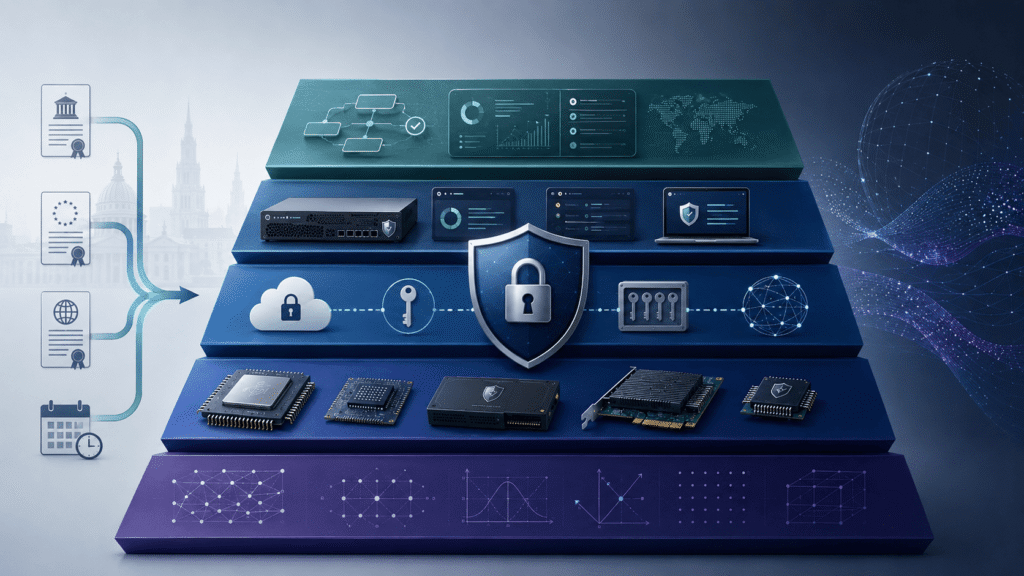
As governments order a worldwide switch to quantum-resistant encryption, security spending is flowing through a value chain where the biggest profits and the best-known names rarely sit in the same place. This scramble to defend the world’s data against quantum computers has matured into a real industry, and the money in this post-quantum cybersecurity market is not landing where most people assume.
It’s important to not that this hasn’t always been the case. The post-quantum cybersecurity market wasn’t a market at all, it was a research topic for decades. It is now a market with deadlines, budgets and a growing roster of vendors. The shift has been driven less by the arrival of a code-breaking quantum computer, which still does not exist, than by regulators who have decided that organizations cannot afford to wait for one. The result is a fast-growing market whose value is concentrated in places that surprise newcomers: not in the celebrated mathematics of new encryption, but in the hardware, integration work and consulting services needed to put that mathematics into use.
How large the market is depends on whom you ask. Grand View Research estimated the global post-quantum cryptography market at about $1.58 billion in 2025 and projected it would reach roughly $20.5 billion by 2033, a compound annual growth rate near 38%. Other firms are more conservative, placing the 2025 figure closer to $810 million, while a few aggressive forecasts reach into the tens of billions by 2035. The wide spread is an initial sign for buyers and investors that the numbers diverge mostly because analysts disagree on what counts as the market, particularly whether to include specialized quantum hardware alongside software-based encryption. Treat any single figure as one scenario, not a fact.
Why is post-quantum cybersecurity market suddenly real?
Because regulators have turned a theoretical threat into a compliance deadline. In 2024, the U.S. National Institute of Standards and Technology, known as NIST, finalized its first standards for post-quantum cryptography, or PQC. PQC refers to new encryption algorithms, built on harder mathematical problems, that are believed to resist attack by quantum computers and, crucially, can run on the ordinary computers and networks organizations already own. The standards, designated FIPS 203, 204 and 205, gave the world a common baseline and set off a wave of adoption.
Government mandates followed quickly. The U.S. National Security Agency has said current encryption should be phased out of national security systems by 2030 and prohibited by 2035. The European Commission’s roadmap calls for all 27 member states to begin migrating by the end of 2026 and to protect critical infrastructure by 2030. Canada’s federal roadmap envisions initial migration plans by April 2026 and full migration by 2035.
One highly cited reason for the urgency is a tactic security researchers call “harvest now, decrypt later.” Adversaries can intercept and store encrypted data today, then wait until a powerful enough quantum computer can unlock it. For data with a long shelf life, such as medical records, financial transactions and state secrets, that future threat is a present-day problem. The Global Risk Institute, which publishes a widely cited annual assessment with the firm evolutionQ, estimated in its 2026 report that a cryptographically relevant quantum computer is “quite possible” within 10 years and “likely” within 15. No one knows the date. The mandates do not wait for it.
Where does the value actually sit?
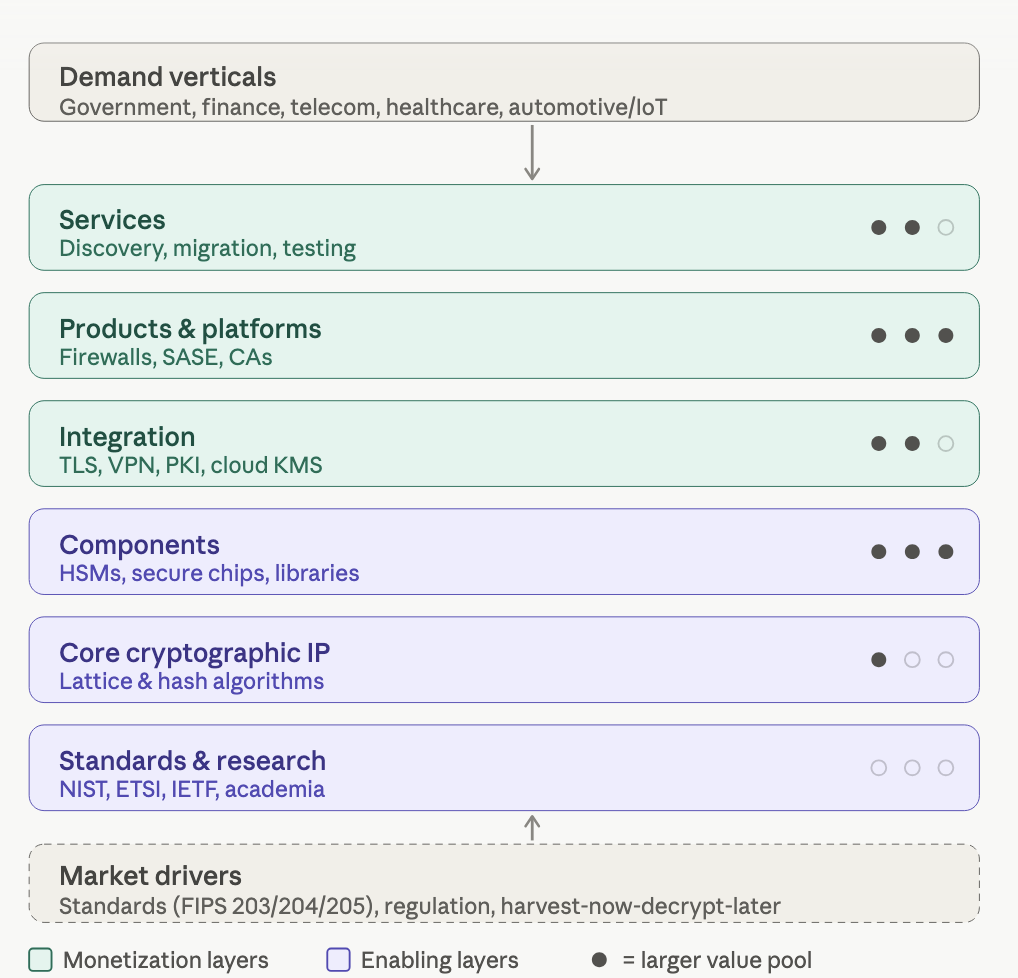
The value in the post-quantum cybersecurity market does not rest in the algorithms themselves, as many might assume. The post-quantum market is best understood as a stack of layers, and revenue is distributed unevenly across them. At the bottom sit the standards bodies and academic researchers, including NIST, the European Telecommunications Standards Institute and the Internet Engineering Task Force. They shape everything above them but capture almost no revenue. Just above them is the core cryptographic intellectual property, the algorithms themselves. Lattice-based cryptography, the dominant approach, accounted for more than 50% of market revenue in 2025, according to Grand View Research, but the algorithms are largely public standards, so this layer is a surprisingly thin profit pool.
The money begins in the next layer up: components. Hardware security modules, secure chips, and the cryptographic software libraries that developers build on represent one of the largest value pools in the market today. This is where semiconductor companies compete. Above components is integration, the work of embedding quantum-safe encryption into the plumbing of the internet, including the TLS protocol that secures websites, virtual private networks, public-key infrastructure and cloud key-management services. Higher still are finished products and platforms, such as firewalls, secure-access service edge offerings and certificate authorities.
The fastest-growing pool is at the top: services. Because every system that uses public-key encryption must eventually be found, assessed and migrated, demand is surging for cryptographic discovery, risk assessment, migration consulting and testing. This work is compliance-driven, which makes its near-term revenue more visible than that of many other quantum technologies. The practical lesson for anyone sizing the market is to beware of double counting. A single large vendor may sell across the chip, integration, platform and services layers at once, so adding up segment revenues without attributing each vendor to a primary role will overstate the total.
Who are the major players?
The post-quantum cybersecurity market divides into several camps that increasingly overlap. Cloud hyperscalers and platform giants, including Amazon Web Services, Google, Microsoft and Cloudflare, are building quantum-safe encryption into their infrastructure; Cloudflare introduced a PQC-enabled secure-access platform in early 2026. Network and security vendors such as Palo Alto Networks, Cisco, Fortinet and Thales are adding quantum features to existing products, with Palo Alto having launched a quantum-readiness dashboard in 2025.
Semiconductor companies, among them NXP Semiconductors, Infineon Technologies, STMicroelectronics, Microchip Technology, Intel and Lattice Semiconductor, are embedding standardized algorithms into chips for government, automotive and industrial customers. A cluster of specialist firms, including PQShield, SandboxAQ, ISARA, Crypto4A and Cryptomathic, focus purely on quantum-safe technology. Consultancies have also moved in; Bain & Co. announced a collaboration with IBM in 2026 to deliver post-quantum risk assessments and migration services.
A separate group sells quantum key distribution, or QKD, which uses the physics of light rather than mathematics to exchange encryption keys but requires specialized optical hardware. Providers include ID Quantique, acquired by IonQ in 2025, along with QuantumCTek and KETS Quantum Security. Most experts recommend PQC as the primary migration path and treat QKD as an additional layer for the most sensitive applications, not a replacement.
How should buyers and investors act?
For organizations, the first step is a cryptographic inventor, which is, essentially, knowing where encryption lives across systems, applications and vendors, because migration touches nearly all of it. Security specialists advise prioritizing data with long confidentiality requirements, which is why finance, government, defense, healthcare and telecommunications are leading early deployments. Buyers should also demand “crypto-agility,” the ability to swap encryption algorithms as standards evolve, rather than locking into a single scheme. Free, authoritative resources include NIST’s post-quantum cryptography project, the NSA’s CNSA 2.0 guidance and national migration roadmaps published by several governments.
For investors, the post-quantum cybersecurity market value map suggests where compliance-driven revenue is most visible in the near term: in the component makers selling quantum-ready chips and modules, and in the services firms guiding migrations. Pure-play algorithm developers, by contrast, sit on a thinner pool. The headline market-size figures will keep diverging, but the structure beneath them is stable. The mandates are set, the standards are published, and the migration has begun. The open question is no longer whether the post-quantum cybersecurity market is real, but which layers of it will capture the spending now flowing in.