

Fraunhofer IPMS has introduced a quantum random number generator designed to supply high-speed entropy for cryptography, authentication and other security systems as demand grows for stronger sources of randomness in quantum-era infrastructure.
The Dresden-based Fraunhofer Institute for Photonic Microsystems reported in a news release that its Q-Dice system generates true random numbers from quantum vacuum fluctuations, reaching bit rates above 4 Gbit/s. The institute is positioning the technology for security-critical uses, including secure communication, data encryption, quantum key distribution, post-quantum cryptography, authentication, access management and large-scale simulation.
Randomness is a basic but often overlooked part of cybersecurity. Encryption systems, digital signatures, authentication protocols and secure key generation depend on random numbers that cannot be predicted. Weak random number generators can create hidden vulnerabilities even when the encryption algorithms themselves are strong.
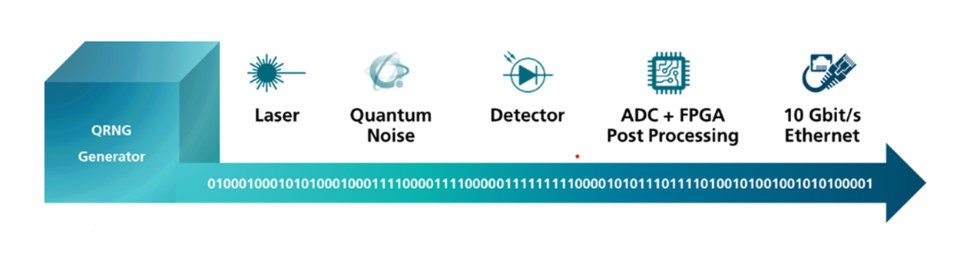
Q-Dice is aimed at that problem. Rather than relying on deterministic software algorithms, the system measures quantum vacuum fluctuations, a physical process that is described as intrinsically random and uncontrollable. Fraunhofer IPMS said the result is a source of quantum entropy that can be integrated into hardware infrastructure or accessed through a cloud-based service.
The announcement comes as the security community prepares for two overlapping shifts. One is the move toward post-quantum cryptography, which is intended to protect classical systems from future quantum computers capable of breaking widely used public-key encryption. The other is the development of quantum-secure communication systems, including QKD, which uses quantum effects to help distribute encryption keys.
Both areas require high-quality entropy. Post-quantum algorithms still depend on secure key generation, while QKD systems require trusted random numbers for protocol operation, basis choices and other security functions. For organizations planning long-term cryptographic migration, the reliability of entropy sources is part of the broader security stack.
Fraunhofer IPMS said Q-Dice has been validated through established testing frameworks, including BSI AIS 20/31 and the NIST SP 800-22 test suite. The system is also classified at EAL 3 and PTG 3, according to the institute. Those classifications are intended to provide evidence that the system meets security and evaluation requirements, particularly for users in regulated or high-assurance environments.
“With Q-Dice, we make high-quality quantum randomness practically usable and accessible,” Dr. Alexander Noack, division director for Data Communication & Computing at Fraunhofer IPMS, said in the announcement. “Whether as a robust 19-inch rack system integrated into your own infrastructure or via our online Entropy-as-a-Service platform, we are removing the barriers to adopting quantum-level security.”
Fraunhofer IPMS said the system was developed through in-house control of the main technical components, including laser and optical front-end design, low-noise analog front-end electronics, high-speed data acquisition, FPGA-based randomness extraction and system integration. The hardware includes 10 Gbit/s Ethernet connectivity for high-throughput environments.
The institute is offering Q-Dice in two forms. The first is a 19-inch rack-mounted hardware appliance for on-premises deployment in data centers and enterprise environments. The second is an online QRNG service, described as Entropy-as-a-Service, that allows users to access quantum-generated randomness without installing dedicated hardware.
The cloud model could make the technology easier to test in software systems and cloud applications, while the appliance model may appeal to organizations that need direct control over infrastructure or operate under stricter security requirements.
Fraunhofer IPMS said it is seeking partners to pilot the technology and develop real-world applications.
“We’re inviting partners to pilot the technology and co-create real-world applications,” Noack said. “Our goal is to work together to raise the bar for security and trust in the digital age.”