For roughly three decades, most public-key encryption has relied on mathematical problems—integer factorization and discrete logarithms—that conventional computers cannot solve efficiently. A sufficiently large, fault-tolerant quantum computer running Shor’s algorithm could solve them, undermining the cryptography that protects internet traffic, financial transactions, and government communications. No such machine is known to exist today. The widely cited near-term concern is instead the “harvest now, decrypt later” risk, which means quantum-resistant cryptography is needed because adversaries collect encrypted data now and decrypt it once the hardware becomes available.
That concern moved post-quantum cryptography (PQC) from research to procurement. In August 2024, the U.S. National Institute of Standards and Technology (NIST) published its first three finalized standards: ML-KEM (FIPS 203, derived from CRYSTALS-Kyber), ML-DSA (FIPS 204, formerly CRYSTALS-Dilithium), and SLH-DSA (FIPS 205, based on SPHINCS+). In March 2025, NIST selected HQC, a code-based algorithm, as a backup, with a Falcon-based signature scheme (FN-DSA) still in standardization.
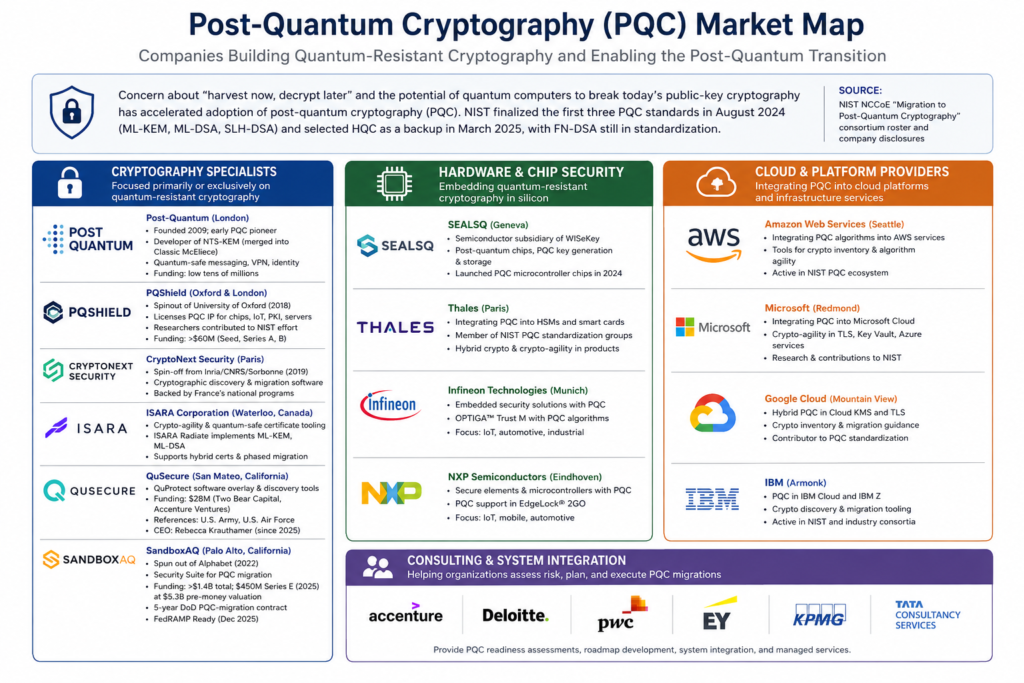
One non-commercial reference point for identifying active participants is the consortium roster of NIST’s National Cybersecurity Center of Excellence (NCCoE) “Migration to Post-Quantum Cryptography” project. Organizations joined by responding to an open call in the Federal Register and signing a Cooperative Research and Development Agreement; the roster reflects participation rather than rank or endorsement. NCCoE maintains and updates the list. The companies below are the technology providers drawn from that roster, grouped by their primary role in the transition. Funding figures, leadership, and product status come from company disclosures and contemporaneous reporting and can change quickly.
The following is a non-exhaustive list of some of the companies and organizations that are creating the backbone of the post-quantum cryptography industry.
Cryptography Specialists
These companies that are pioneers in the quantum-resistant cryptography industry are focused primarily or exclusively on quantum-resistant cryptography.
Post-Quantum (London). Founded in 2009, the company describes itself as among the earliest dedicated to post-quantum cryptography. Its founder and chief executive, Andersen Cheng, previously held senior roles at JPMorgan and the Carlyle Group and ran TRL, a UK supplier of government-grade encryption. With co-founders CJ Tjhai and Martin Tomlinson, the company developed an algorithm, NTS-KEM, that was later merged into Classic McEliece, a code-based candidate in the NIST process. The company also markets quantum-safe messaging, VPN, and identity products and states that its technology has been used to protect NATO communications. Public disclosures indicate it has raised in the low tens of millions of dollars.
PQShield (Oxford and London). A 2018 spinout of the University of Oxford’s Mathematical Institute, founded by cryptographer Ali El Kaafarani, a former Hewlett-Packard Labs engineer. The company licenses PQC intellectual property for secure elements, IoT firmware, public-key infrastructure, and server hardware. It has raised more than $60 million across seed, Series A (2022) and Series B (2024) rounds, with investors including Addition, Oxford Science Enterprises, Chevron Technology Ventures, and Legal & General. The company says it has advised the White House, the European Parliament, the World Economic Forum, and the UK National Cyber Security Centre, and its researchers contributed to the NIST standardization effort.
CryptoNext Security (Paris). Founded in 2019 as a spin-off from the Polsys research team affiliated with Inria, CNRS, and Sorbonne University. Its founders, Ludovic Perret and Jean-Charles Faugère, are academic cryptographers; Faugère is known for the F4 and F5 Gröbner-basis algorithms used in algebraic cryptanalysis. The company provides cryptographic discovery and migration software and has been supported under France’s national investment programs.
ISARA Corporation (Waterloo, Canada). A developer of crypto-agility and quantum-safe certificate tooling that predates the finalized NIST standards. Its ISARA Radiate toolkit implements ML-KEM and ML-DSA and supports hybrid certificates and phased migration, with marketing aimed at organizations subject to U.S. directives such as NSM-10 and OMB M-23-02.
QuSecure (San Mateo, California). Founded in 2019 by Skip Sanzeri, Dave Krauthamer, Rebecca Krauthamer, and Kosta Vilk. Its QuProtect product is a software overlay intended to add crypto-agility to existing infrastructure, along with discovery tooling for cryptographic inventories. The company reports raising $28 million, with investors including Two Bear Capital and Accenture Ventures, and lists U.S. Army and Air Force engagements among its references. Co-founder Rebecca Krauthamer, previously the company’s chief product officer, became chief executive in 2025.
SandboxAQ (Palo Alto, California). Spun out of Alphabet in 2022 and led by Jack Hidary. The company reports raising more than $950 million in total since the spinout, including a $450 million Series E in 2025 that, according to contemporaneous reporting, valued it at roughly $5.6 billion. Its enterprise PQC offering, the Security Suite, sits within a broader portfolio that also addresses navigation, drug discovery, and large quantitative models. The company has disclosed a five-year U.S. Department of Defense PQC-migration agreement and, in December 2025, FedRAMP Ready status. It has named Dow Chemical, the Mayo Clinic, and government customers in Bahrain among its deployments.
Hardware and Chip Security
This group of the quantum-resistant cryptography industry focuses on embedding quantum-resistant cryptography in silicon, where keys are generated and stored.
SEALSQ (Geneva). A semiconductor subsidiary of Swiss group WISeKey, listed on Nasdaq under the ticker LAES and led by founder Carlos Creus Moreira. SEALSQ develops secure-element and TPM-class chips that incorporate lattice-based algorithms into hardware roots of trust for applications including authentication tokens, automotive systems, and satellites. The company has issued revenue guidance in the mid-eight figures and reported a substantial cash position.
Crypto4A (Ottawa). Founded in 2017 by engineers who had worked on the Luna hardware security module line associated with Chrysalis-ITS, SafeNet, and Thales. The company develops quantum-safe hardware security modules (QxHSM) and a secrets-management platform (QxVault) certified to FIPS 140-3 Level 3, and states that it is the only vendor with a certified quantum-safe HSM in production.
NXP Semiconductors (Eindhoven). A large maker of secure chips used in payment cards, identity documents, automotive systems, and IoT devices. NXP has incorporated post-quantum capability into its secure elements, and its researchers have participated in the standardization process.
Utimaco (Aachen, Germany). A long-established hardware security module and key-management vendor that has added quantum-resistant algorithms to its firmware, serving banking and government customers.
Other hardware-oriented participants include PQSecure Technologies, which develops embedded PQC intellectual property for resource-constrained devices, and Kudelski IoT, the IoT-security unit of Switzerland’s Kudelski Group.
Public-Key Infrastructure And Crypto-Agility
Companies in the quantum-resistant cryptography industry that manage certificates and cryptographic assets have positioned the transition as an extension of their existing businesses.
DigiCert, a large certificate authority, has issued test and hybrid PQC certificates and built quantum-readiness features into its DigiCert ONE platform. Entrust brings a public-key infrastructure and HSM portfolio (including its nShield line) to the same market.
Keyfactor focuses on discovering, inventorying, and rotating cryptographic assets across enterprise environments.
Specialist vendors in this category include InfoSec Global, whose AgileSec platform addresses cryptographic discovery and agility; SafeLogic, which provides FIPS-validated cryptographic libraries and has collaborated with the Open Quantum Safe project; and Information Security Corporation, a long-running cryptographic-toolkit developer.
Platform and Infrastructure Providers
Large technology companies are integrating PQC into widely used products and services.
IBM researchers, working with academic and industry partners, developed CRYSTALS-Kyber (now ML-KEM) and CRYSTALS-Dilithium (now ML-DSA); a co-developer of SPHINCS+ (SLH-DSA) subsequently joined the company. IBM has marketed its z16 mainframe as quantum-safe.
Google has tested and deployed hybrid post-quantum key exchange in its Chrome browser and internal systems over several years, beginning with early experiments and progressing to ML-KEM-based key agreement. Cloudflare has contributed an open-source cryptography library (CIRCL), published research, and enabled post-quantum key agreement across its network. Amazon Web Services contributes to the Open Quantum Safe project, supports PQC in its s2n-TLS implementation, and has added hybrid post-quantum key exchange to certain services.
Microsoft maintains an active cryptography research group; its isogeny-based SIKE candidate was withdrawn after researchers demonstrated a classical attack in 2022, an outcome often cited as a reminder that candidate algorithms must withstand classical as well as quantum cryptanalysis. Cisco is integrating PQC into network and security products, and Samsung SDS is incorporating it into enterprise and mobile offerings. Thales appears on the roster through two units—Thales DIS CPL, associated with its Luna HSM and payShield products, and the U.S.-focused Thales Trusted Cyber Technologies. IDEMIA Secure Transactions is applying PQC to payment cards and identity documents.
Networking, Enterprise Security, and Systems Integration
A further group is adding PQC options to established products. Palo Alto Networks, Fortinet, and F5 are incorporating quantum-resistant options into firewalls, VPNs, and application-delivery systems. wolfSSL, an embedded TLS library, added support for the new algorithms through the Open Quantum Safe project. SSH Communications Security, the Finnish company founded by Tatu Ylönen, who developed the SSH protocol in 1995, offers quantum-safe options for secure access. Systems and infrastructure participants include NTT Data, Siemens, Dell Technologies, HP, Tenable, Verizon, and the test-and-measurement company Viavi.
What’s Next?
The roster also includes smaller and newer companies with limited public disclosure, among them AvInyaSQ, CyberSeQ, cyberzero, Qinvicta, and Tectonic. It further includes Quantum Xchange, whose Phio platform supports both software-based PQC and hardware quantum key distribution, allowing customers to combine the two. Participation in a NIST-convened consortium indicates engagement with the standardization and testing process; it is not a measure of market position.
The post-quantum transition differs from many technology shifts in that demand is driven largely by risk mitigation and regulatory direction rather than by new end-user functionality. The participant base reflects that: dedicated startups, university spin-offs commercializing standardized algorithms, established HSM and PKI vendors, and large platform providers integrating the new standards into existing infrastructure. The NCCoE roster is one independent indicator of who is actively engaged in the work. It does not assess commercial performance, and inclusion should not be read as a ranking.