
Healthcare organizations are racing to digitize patient care, but a new study reports these organizations must also prepare for quantum computing, a cybersecurity challenge that could arrive years before many institutions are ready.
Researchers writing in the International Journal of Theoretical and Applied Computational Intelligence warn that advances in quantum computing could eventually undermine the cryptographic systems that protect electronic health records, telemedicine platforms, medical devices and cloud-based healthcare infrastructure. The study concludes that healthcare organizations should begin planning now for the adoption of post-quantum cryptography, or PQC, to protect sensitive medical information against future attacks.
The warning comes as hospitals and healthcare providers become increasingly dependent on connected technologies. Electronic health records, artificial intelligence-assisted diagnostics, wearable sensors, cloud-based data exchanges and the Internet of Medical Things have transformed patient care. At the same time, they have expanded the number of systems that must be secured against cyber threats.
According to the researchers, the healthcare sector faces a unique challenge because medical information often remains sensitive for decades. Unlike a credit card number, which can be changed after a breach, a patient’s medical history, biometric information, or genetic data may retain value for a lifetime.
That long-term sensitivity makes healthcare a particularly important sector in the emerging transition toward quantum-safe cybersecurity.
Why Quantum Computing Matters for Healthcare
Modern cybersecurity depends heavily on encryption.
Today, hospitals use a mix of encryption technologies to protect patient information, secure communications between systems, authenticate users and verify the integrity of medical records.
Many of these protections rely on mathematical problems that are extremely difficult for conventional computers to solve.
Quantum computers operate differently.
Rather than processing information as traditional bits that represent either a 0 or a 1, quantum computers use quantum bits, or qubits, which can exist in multiple states simultaneously. Combined with a phenomenon known as entanglement, this allows quantum computers to perform certain calculations much more efficiently than classical machines.
The study highlights two quantum algorithms that are particularly relevant to cybersecurity.
Shor’s algorithm could eventually break widely used public-key cryptography systems such as RSA and elliptic curve cryptography. These technologies are foundational components of secure communications, digital signatures and authentication systems used throughout healthcare environments.
Grover’s algorithm poses a different threat. Rather than completely breaking encryption, it can significantly speed up brute-force attacks against symmetric encryption systems and cryptographic hash functions. The result is a reduction in the effective security strength of many existing cryptographic protections.
Although current quantum computers remain far from the scale needed to execute these attacks against large production systems, researchers note that progress in quantum hardware, error correction and system scalability continues to advance.
For healthcare organizations, the concern is not only when a cryptographically relevant quantum computer arrives. The concern is that sensitive information stolen today could be decrypted years later.
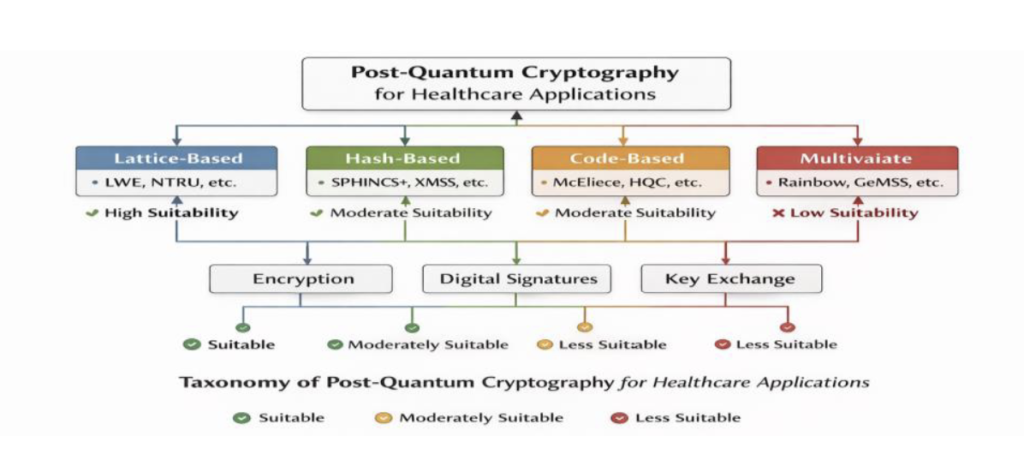
Taxonomy of post-quantum cryptographic approaches for healthcare applications
Healthcare’s ‘Harvest Now, Decrypt Later’ Problem
One of the most significant risks identified in the study is what cybersecurity experts call “harvest now, decrypt later.”
In this scenario, attackers intercept and store encrypted healthcare information today, even if they cannot currently read it.
The expectation is that future quantum computers could eventually decrypt the archived data.
Healthcare information is especially vulnerable to this type of attack because of its long shelf life.
Electronic health records, diagnostic images, genomic data, insurance information and long-term clinical research records may need protection for decades.
The researchers report that this creates a unique security challenge. Even organizations that believe their encryption is secure today may face future exposure if quantum-capable adversaries obtain archived encrypted data.
The study notes that healthcare ecosystems are highly interconnected, with information moving among hospitals, insurance companies, laboratories, research institutions, cloud providers, wearable devices and telemedicine platforms.
Every connection represents a potential point of interception.
Which Healthcare Systems Face the Greatest Risk?
The researchers identify several healthcare technologies that could face elevated risks from quantum-enabled attacks.
Medical Internet of Things devices rank among the most vulnerable.
These devices include implantable medical sensors, infusion pumps, wearable monitors and remote patient monitoring systems. Because many operate with limited computing power and battery capacity, they often rely on lightweight security mechanisms that may be difficult to upgrade.
A successful attack could potentially allow unauthorized access, manipulation of sensor readings, or disruption of device operation.
Telemedicine systems also face substantial exposure.
Remote healthcare services rely heavily on encrypted communications between patients and clinicians. Quantum-enabled attacks could eventually threaten authentication systems, secure video sessions and confidential patient communications.
Cloud-based electronic health record systems represent another high-value target. These platforms aggregate enormous volumes of sensitive patient information and serve as central hubs for healthcare data exchange.
According to the study, a successful compromise of encryption or digital signature mechanisms could lead to large-scale data breaches, unauthorized record modification, or service disruptions.
Clinical decision-support systems present a different category of risk.
These platforms increasingly rely on artificial intelligence and machine learning to assist physicians. If attackers gain the ability to manipulate the integrity of healthcare data or models, the consequences could extend beyond privacy concerns and affect clinical decision-making itself.
Wearable health technologies also face challenges. Continuous monitoring systems generate constant streams of health information that are transmitted to centralized platforms for analysis.
The researchers note that compromised communications could result in altered or fabricated health data, potentially affecting patient care decisions.
The Rise of Post-Quantum Cryptography
The primary defense against future quantum attacks is post-quantum cryptography.
Unlike quantum security technologies that require specialized hardware, PQC consists of cryptographic algorithms designed to run on conventional computers while resisting both classical and quantum attacks.
This compatibility makes PQC attractive for healthcare organizations because it can often be deployed through software upgrades rather than complete infrastructure replacement.
The study reviews four major categories of post-quantum cryptography.
Lattice-based cryptography has emerged as the leading candidate for many applications. Its security relies on mathematical problems that currently appear resistant to both classical and quantum attacks.
Researchers describe lattice-based systems as particularly suitable for healthcare environments because they support encryption, digital signatures and secure key exchange while offering strong security assurances.
Hash-based cryptography represents another option, particularly for digital signatures. These systems rely on the security properties of cryptographic hash functions and provide strong theoretical guarantees against quantum adversaries.
Code-based cryptography is built on the difficulty of decoding random linear codes. These schemes have withstood decades of cryptanalysis but often require larger public keys, creating deployment challenges in bandwidth-constrained environments.
Multivariate cryptography offers fast computations and compact signatures, potentially making it attractive for real-time healthcare applications. However, some proposed schemes have been broken over time, leading researchers to recommend cautious evaluation before widespread adoption.
The study notes that no single approach is ideal for every healthcare use case. Instead, organizations will likely need to select cryptographic solutions based on system requirements, performance constraints and security objectives.
Beyond PQC: Layered Quantum-Resilient Security
According to the researchers, post-quantum cryptography alone will not solve every security challenge.
Instead, they advocate a layered defense strategy that combines multiple technologies.
One approach involves hybrid cryptographic deployments that use both traditional and post-quantum algorithms simultaneously during a transition period.
This strategy allows organizations to maintain compatibility with existing systems while gradually introducing quantum-resistant protections.
The study also examines Quantum Key Distribution, or QKD.
QKD uses the laws of quantum mechanics to exchange encryption keys in a way that can reveal eavesdropping attempts. While promising for highly sensitive healthcare communications, the researchers note that QKD remains constrained by infrastructure requirements and deployment complexity.
Quantum Random Number Generation, or QRNG, may offer more immediate benefits.
Random numbers are essential for cryptographic security. QRNG systems use quantum processes to generate genuinely random values that can strengthen encryption, authentication and key generation.
The researchers suggest QRNG may be easier to integrate into existing healthcare systems than QKD because it requires fewer architectural changes.
Blockchain systems enhanced with post-quantum signatures also receive attention in the study as potential tools for maintaining data integrity, consent tracking and medical record auditability.
Regulation, Compliance and Patient Trust
The transition to quantum-safe healthcare extends beyond technology.
The study reports that regulators and policymakers will eventually need to address quantum risks within existing healthcare privacy frameworks.
Laws such as HIPAA in the United States and GDPR in Europe require organizations to protect sensitive information, but they were developed before quantum computing became a realistic cybersecurity concern.
According to the researchers, healthcare providers may increasingly face pressure to demonstrate preparedness for future quantum threats, particularly when managing long-lived medical records.
Patient trust is another important consideration.
Healthcare depends on the confidence that sensitive personal information will remain protected. A future quantum-enabled breach of historical medical data could undermine public trust in digital healthcare systems and raise significant ethical concerns.
The researchers also highlight potential disparities in adoption.
Large healthcare systems may have the resources needed to implement quantum-safe technologies more quickly than smaller hospitals and clinics. Policymakers may need to address these gaps to ensure equitable access to advanced cybersecurity protections.
The Road Ahead
The study concludes that healthcare organizations should begin preparing now rather than waiting for large-scale quantum computers to arrive.
The researchers call for broader testing of post-quantum cryptographic algorithms in medical devices, electronic health record platforms and real-time healthcare applications. They also advocate further research into hybrid security architectures that combine classical and quantum-resistant technologies.
Perhaps most importantly, they report that quantum security should be viewed as a long-term strategic issue rather than a future technical upgrade.
Healthcare data has a lifespan measured in decades. Because of that reality, decisions made today about encryption, infrastructure and cybersecurity planning may determine whether sensitive medical information remains protected in the quantum era.
For hospitals, health systems and healthcare technology providers, the message is straightforward: the transition to post-quantum cybersecurity may take years and the organizations that begin planning earliest will likely be best positioned to protect patient data when quantum computing eventually reaches cryptographic scale.
The research team included Ateeq Ur Rehman Butt of the Department of Computer Science at the University of Kamalia in Kamalia, Pakistan and Muhammad Asif of the Department of Computer Science at National Textile University in Faisalabad, Pakistan. The study also included Muhammad Atif Rasheed of the Business Transformation and Program Management department at the University of Toronto in Canada, as well as Sumaira Shafiq of the Department of Computer Science at the University of Poonch Rawalakot in Azad Kashmir, Pakistan.