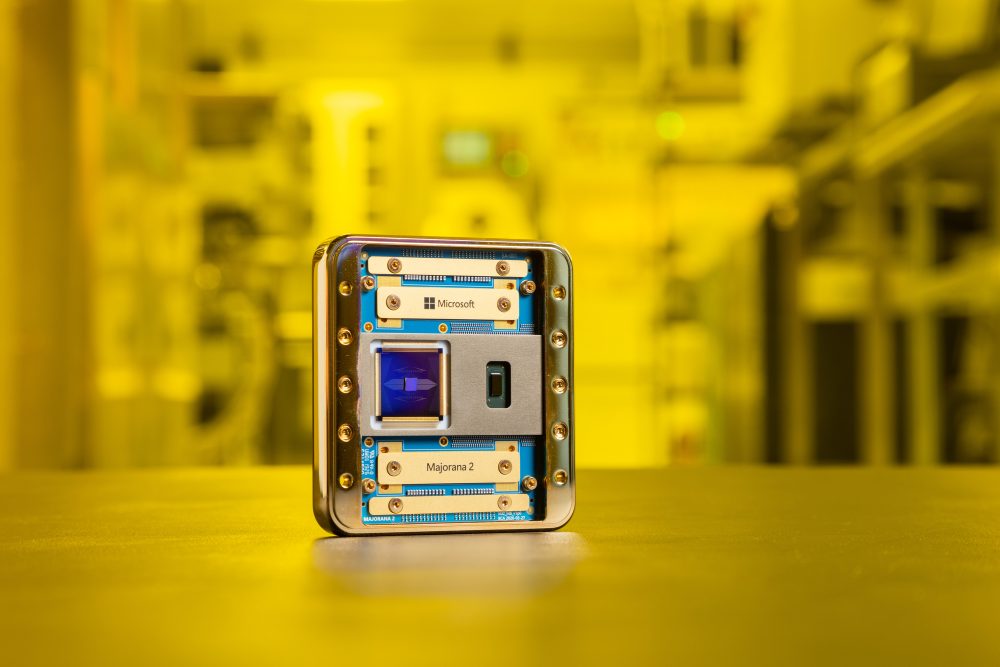
Microsoft says its latest topological quantum processor has achieved a more than 1,000-fold increase in qubit stability, a result the company suggests supports a faster path toward fault-tolerant quantum computing and adds urgency to ongoing post-quantum cybersecurity preparations.
The company unveiled its new Majorana 2 processor this week in an announcement, reporting qubit lifetimes exceeding 20 seconds and, in some cases, more than one minute. Microsoft also said the engineering advances behind the device have allowed it to cut its projected timeline for a scalable quantum computer in half, with a target date of 2029.
The performance of this chip offers insights into the quickening pace of quantum development. While a machine capable of breaking modern public-key cryptography remains years away, Microsoft’s revised roadmap places it among a small group of companies targeting fault-tolerant quantum systems before the end of the decade.
The announcement also arrives amid continued debate over Microsoft’s topological quantum computing strategy. The company’s Majorana 1 announcement in 2025 generated significant scrutiny from physicists, many of whom questioned whether Microsoft had provided sufficient evidence for the exotic quantum states underlying its architecture. Microsoft maintains that its approach is sound and points to continued participation in DARPA’s quantum benchmarking efforts as evidence that independent evaluators consider the roadmap credible.
In light of scrutiny over last year’s announcement, the focus is about the new results emphasize measurable engineering improvements in devices designed to use them, rather than the existence of Majorana states, .
Majorana 2 replaces aluminum, the superconducting material used in earlier devices, with lead. Microsoft said AI-assisted materials design helped researchers identify and manufacture the new structure, overcoming fabrication challenges that had previously limited the use of lead in quantum processors. According to the company, the new material stack increased the topological gap protecting the qubits from about 30 microelectronvolts to roughly 70 microelectronvolts.
While those numbers may sound small, the impact is substantial. The topological gap acts as a protective energy barrier that helps shield quantum information from environmental disturbances. According to the technical paper, the larger gap contributed to parity lifetimes exceeding 20 seconds, compared with one to 12 milliseconds in previous aluminum-based devices.
Parity refers to whether a quantum structure contains an even or odd number of electrons. In Microsoft’s architecture, quantum information is encoded in that parity state. A parity flip therefore represents a potential computational error. Extending parity lifetimes from milliseconds to tens of seconds means the encoded information remains stable far longer before an unwanted change occurs.
Researchers reported a characteristic parity lifetime of approximately 22 seconds, with some measurements exceeding one minute. The paper notes that these lifetimes are more than seven orders of magnitude longer than the microsecond-scale operations required to perform quantum calculations.
That does not mean the machine is close to breaking RSA or elliptic-curve cryptography. The device remains a research processor, not a fault-tolerant quantum computer. But it does indicate that one of the key challenges in Microsoft’s architecture — maintaining stable quantum information long enough to perform useful computations — has improved significantly.
Indirect but Important Cybersecurity Implications
The primary threat quantum computing poses to current cybersecurity systems stems from Shor’s algorithm, which could theoretically break widely used public-key cryptography schemes once sufficiently large, fault-tolerant quantum computers become available. Governments, standards bodies and enterprises have spent the past several years preparing for that possibility by adopting post-quantum cryptographic standards.
Organizations are already facing what security experts call the “harvest now, decrypt later” problem. Sensitive data stolen today could be stored and decrypted years later if a cryptographically relevant quantum computer eventually becomes available. As a result, the transition to post-quantum cryptography is increasingly being driven by long-term risk management rather than expectations of an immediate quantum threat.
Announcements such as Microsoft’s Majorana 2 therefore matter less because of their immediate technical capabilities and more because they provide signals about industry progress.
The company reports that the new processor validates a central principle of topological quantum computing: increasing the energy gap protecting a qubit can dramatically reduce errors. If that relationship continues as systems scale, Microsoft believes it can build fault-tolerant machines more efficiently than conventional quantum architectures.
DARPA’s Testing
DARPA appears willing to test that proposition. Microsoft remains one of only two companies selected for the final phase of the agency’s Underexplored Systems for Utility-Scale Quantum Computing program, part of the broader Quantum Benchmarking Initiative. The program brings together experts from government laboratories, federally funded research centers and academia to evaluate whether competing quantum architectures can realistically reach utility-scale performance.
That external validation does not guarantee success. Majorana-based quantum computing remains one of the most ambitious and controversial approaches in the field. Significant scientific and engineering hurdles remain before any topological quantum computer reaches commercial scale.
Still, Microsoft’s revised timeline is notable because it moves a previously open-ended roadmap onto a specific date. The company had previously described useful quantum computers as being years away rather than decades away. The new 2029 target places the technology within the planning horizon of many cybersecurity programs and enterprise technology roadmaps.
For cybersecurity leaders, the practical takeaway is not that quantum computers are about to break encryption. It is that major industry players continue to report measurable progress toward fault-tolerant systems, and some are becoming more confident about when those systems may arrive.
Whether Microsoft ultimately achieves its 2029 goal remains uncertain. What is becoming harder to dismiss is the possibility that cryptographically relevant quantum computing may emerge on timelines that matter for today’s security decisions.